
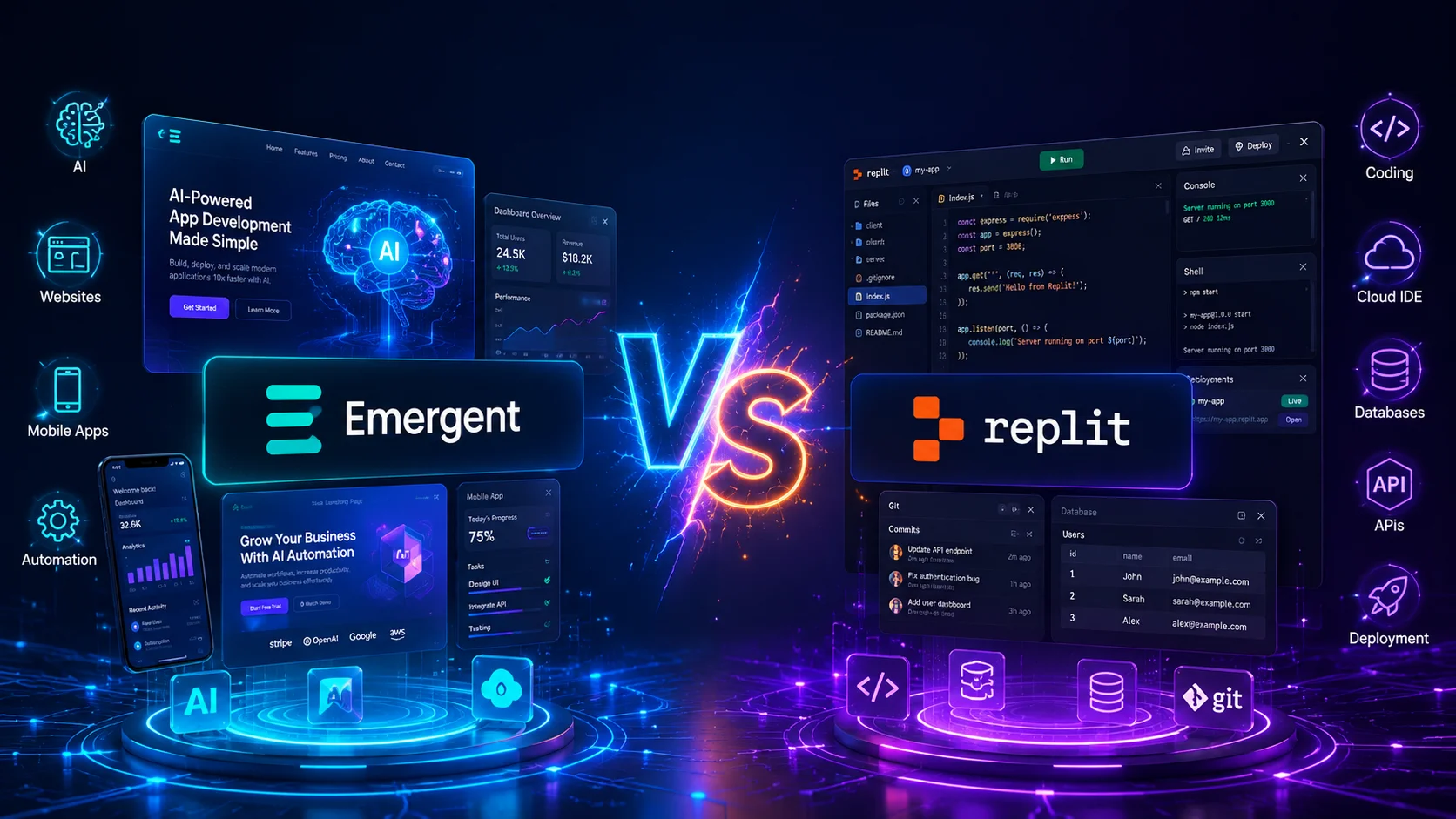
Emergent vs Replit for Developing Apps, Websites, Pages, and More
The rise of artificial intelligence (AI) has transformed the way software is built. Today, creating an application or website no longer requires months of coding or an experienced development team. AI-powered development platforms have made it possible for entrepreneurs, businesses, freelancers, students, and even non-programmers to build functional digital products with remarkable speed. Among the growing number of AI coding platforms, Emergent and Replit have gained significant attention because both promise to simplify software development while improving productivity.
Although both platforms use AI to assist with coding, they follow very different approaches. Emergent is designed as an AI-first application builder that converts natural language prompts into complete projects, making it attractive for users who want to launch products quickly. Replit, on the other hand, is a cloud-based development environment that combines a traditional coding workspace with advanced AI assistance, giving developers greater flexibility and control over their applications.
This difference often creates confusion among users planning to build a website, landing page, web application, SaaS product, mobile application, portfolio, dashboard, or business tool. Some users believe that AI-generated code is sufficient for every project, while others prefer writing and controlling every line of code manually. The reality lies somewhere between these two approaches, and understanding the strengths and limitations of each platform is essential before making a decision.
In this detailed comparison of Emergent vs Replit for developing apps and websites, we will examine every major aspect that influences the development process. Rather than focusing only on AI capabilities, we will also compare their user experience, coding flexibility, collaboration features, deployment options, scalability, pricing, security, and overall value for different types of users. Whether you are an experienced software engineer, a startup founder, a digital agency, or someone building your first website, selecting the right platform can save countless hours while improving the quality of your final product.
One important point to remember is that there is no universal winner. A platform that is perfect for a beginner may not satisfy an experienced developer managing enterprise-scale applications. Likewise, a tool that excels at rapid prototyping may not offer the depth required for long-term software maintenance. Therefore, the best choice depends on your technical knowledge, project complexity, future growth plans, and preferred workflow.
Instead of assuming one platform is automatically superior, this comparison evaluates where each platform performs exceptionally well and where improvements are still needed. By the end of this guide, you will have a much clearer understanding of which solution best suits your development requirements and long-term objectives.
What is Emergent?
Emergent is an AI-powered software development platform designed to transform simple text instructions into fully functional digital products. Instead of beginning with a blank coding editor, users describe their idea in plain language, and the AI generates project structures, user interfaces, components, application logic, and supporting code. This approach significantly reduces development time and allows individuals with limited programming knowledge to create professional-looking applications.

The platform focuses on accelerating the creation of websites, landing pages, dashboards, business portals, internal tools, SaaS applications, and modern web interfaces. Users can continue refining the generated project through additional prompts, making the development process feel more conversational than technical.
One of Emergent’s greatest strengths is its emphasis on rapid product creation. Entrepreneurs who want to validate a business idea, freelancers creating client prototypes, and startups developing a minimum viable product (MVP) can often produce usable applications much faster than through traditional development methods.
Another advantage is its ability to generate clean user interface layouts with responsive design principles. Instead of spending hours arranging components manually, users receive organised pages that often require only minor adjustments before deployment. This makes Emergent particularly attractive for users who prioritise speed over extensive manual coding.
However, AI-generated applications should still be reviewed carefully. While Emergent produces impressive results for many standard business scenarios, highly specialised applications, enterprise-level architecture, or complex backend systems may still require experienced developers to customise and optimise the generated code. AI accelerates development, but it does not completely replace software engineering expertise.
Emergent is therefore best viewed as a productivity multiplier rather than a replacement for professional development practices. It helps users move from an idea to a working prototype in a fraction of the traditional development time while leaving room for further enhancement as projects grow.
What is Replit?
Unlike Emergent, Replit is primarily a cloud-based integrated development environment (IDE) that combines coding, testing, debugging, collaboration, deployment, and AI assistance within a single browser-based workspace. Developers can write software in numerous programming languages without installing complex software locally, making Replit one of the most accessible online coding platforms available today.

Its built-in AI assistant helps developers generate code, explain programming concepts, fix errors, suggest improvements, and accelerate repetitive development tasks. Rather than replacing coding, Replit enhances the coding experience by reducing manual effort while allowing developers to maintain complete control over their applications.
One of Replit’s strongest advantages is flexibility. Developers are free to build everything from simple websites to sophisticated APIs, automation tools, databases, machine learning projects, backend services, educational applications, and full-stack software. Because the environment resembles a traditional development workspace, experienced programmers can work efficiently while beginners also benefit from AI guidance and cloud accessibility.
Collaboration is another area where Replit performs particularly well. Multiple developers can work on the same project simultaneously, making it suitable for teams, classrooms, software agencies, and distributed organisations. Since projects are stored in the cloud, development can continue from virtually any device with internet access.
Rather than focusing solely on rapid AI generation, Replit supports the complete software development lifecycle. Developers can continuously edit, improve, debug, deploy, and maintain applications within the same ecosystem, making it an attractive long-term solution for growing projects.
Although Replit includes powerful AI capabilities, it still expects users to understand at least the fundamentals of software development. Beginners can certainly learn on the platform, but those seeking an almost entirely automated development experience may find Emergent more approachable during the initial stages of product creation.
Feature Comparison: Emergent vs Replit
Although both Emergent and Replit utilise artificial intelligence to simplify software development, their core philosophy differs considerably. Understanding these differences is essential before choosing a platform for your next project.

Emergent is built around the concept of AI-driven project generation. Instead of beginning with an empty editor, users simply describe what they want to build. The AI interprets the request and generates the application’s layout, components, business logic, navigation, and much of the required code automatically. This significantly reduces the time needed to create a functional prototype or an initial version of a product.
In contrast, Replit follows the traditional software development workflow while enhancing it with AI. Developers still write, review, modify, and structure the code themselves, but the AI assistant accelerates repetitive tasks by generating functions, explaining code, identifying errors, and suggesting improvements. This approach provides much greater control over the final application.
For users who want to launch a business idea rapidly, Emergent’s automation can be a major advantage. However, developers who require complete customisation, advanced architecture, or long-term software maintenance often appreciate Replit’s flexibility.
Ease of Use
Ease of use is one of the biggest reasons many people compare Emergent vs Replit for developing apps and websites.
Emergent has been designed for users with little or no programming experience. Its interface focuses on natural language prompts rather than technical configuration. Instead of selecting frameworks, writing code, or organising folders manually, users simply explain their requirements, and the platform performs most of the technical work automatically.
This makes Emergent especially suitable for:
- Entrepreneurs
- Small business owners
- Digital marketers
- Content creators
- Startup founders
- Freelancers creating client prototypes
The learning curve is relatively gentle because users interact with AI more like having a conversation than writing software.
Replit, while beginner-friendly compared to traditional IDEs, still expects users to understand programming basics. The interface includes a code editor, terminal, file manager, console, package management, and deployment settings. Although everything runs inside the browser, users remain responsible for organising and maintaining their projects.
For complete beginners, Replit may initially feel more technical. However, developers often prefer this environment because it closely resembles professional software development tools while remaining much easier to access.
AI Capabilities
Artificial intelligence is the main attraction of both platforms, but their implementation differs significantly.
Emergent relies heavily on AI throughout the entire development process. It can generate:
- Complete application structures
- Responsive user interfaces
- Landing pages
- Forms
- Navigation systems
- Business dashboards
- Authentication flows
- Basic application logic
Rather than assisting developers line by line, Emergent attempts to build an entire solution from a single prompt. Users can then refine the application by requesting modifications, additional pages, or design improvements.
This conversational workflow dramatically accelerates product development, especially during the idea validation stage.
Replit’s AI assistant serves a different purpose. Instead of replacing coding, it enhances developer productivity by:
- Generating functions
- Explaining unfamiliar code
- Detecting programming mistakes
- Suggesting bug fixes
- Refactoring existing code
- Completing repetitive coding tasks
- Providing technical guidance
This makes Replit particularly effective for developers working on larger applications where manual control remains important.
In simple terms, Emergent creates software, whereas Replit helps developers create software.
Website Development
Creating professional websites has become much easier thanks to AI-assisted development platforms.
With Emergent, website generation begins with a written description. Users can request a business website, company profile, portfolio, product showcase, educational platform, or blog homepage, and the AI generates a responsive design accordingly. Layouts often include modern typography, navigation menus, content sections, call-to-action buttons, contact forms, and mobile-friendly responsiveness.
This approach significantly reduces design time and allows businesses to publish professional websites much faster than traditional development methods.
However, highly customised websites requiring unique animations, advanced integrations, or specialised backend functionality may still require additional manual development.
Replit, meanwhile, offers greater flexibility for website creation. Developers can choose virtually any framework or programming language supported by the platform, including modern frontend and backend technologies. This freedom enables complete customisation, making Replit suitable for everything from simple portfolio websites to enterprise web applications.
Because developers maintain direct access to the source code, every component can be modified without the limitations sometimes associated with AI-generated templates.
For users prioritising rapid website creation, Emergent generally provides the faster experience. For projects demanding complete technical control, Replit remains the stronger option.
Application Development
Application development involves far more than attractive interfaces. Modern applications require efficient backend processing, secure authentication, databases, APIs, scalability, and maintainable architecture.
Emergent simplifies the early stages of application development by automatically generating project structures and functional user interfaces. This allows founders and businesses to demonstrate working products quickly without assembling a large development team.
This capability is particularly valuable when creating:
- Minimum Viable Products (MVPs)
- Internal business tools
- Customer portals
- Administrative dashboards
- Booking systems
- Business management applications
Rapid generation enables organisations to validate ideas before investing significant development resources.
Replit, however, offers advantages throughout the complete software development lifecycle. Developers can continuously expand applications, integrate external APIs, connect databases, optimise performance, write custom algorithms, and deploy production-ready software within the same environment.
As applications become more complex, Replit’s traditional development workflow generally provides greater long-term flexibility.
Landing Pages and Marketing Websites
Businesses frequently require landing pages for product launches, advertising campaigns, lead generation, and promotional events.
Emergent performs exceptionally well in this area because its AI understands modern web design principles. Users can request landing pages with hero sections, testimonials, pricing tables, feature highlights, contact forms, and strong call-to-action elements. The generated layouts often follow current design trends and require minimal editing before publication.
Marketing agencies, consultants, coaches, and startup founders can therefore create attractive landing pages within minutes rather than spending days designing them manually.
Replit is equally capable of producing excellent landing pages, but developers generally need to build or customise them directly. Although AI assists with coding, much of the creative process remains in the hands of the developer.
For businesses seeking speed and convenience, Emergent offers a significant advantage in landing page generation. Replit becomes more beneficial when extensive customisation, advanced integrations, or highly interactive user experiences are required.
User Interface and Overall Experience
The overall development experience plays an important role when selecting an AI-powered platform. Even the most advanced features become less useful if the interface is difficult to understand or slows down productivity.
Emergent offers a clean, modern, and AI-focused workspace. The platform is designed around natural language interactions, allowing users to describe their requirements instead of manually configuring every aspect of the project. This conversational workflow makes development feel intuitive, especially for beginners and non-technical users.
Instead of spending time creating folder structures, selecting frameworks, or writing boilerplate code, users can focus on describing their business goals. The AI handles much of the repetitive work, enabling projects to progress rapidly from concept to prototype.
Replit, by comparison, provides an experience that closely resembles a professional development environment. The interface includes a code editor, terminal, file explorer, console, package manager, deployment tools, and collaboration features. While this may appear more technical initially, experienced developers appreciate the familiar workflow and greater level of control.
For users who enjoy coding and want complete visibility into every part of their application, Replit delivers a highly productive environment. Beginners can also benefit from its structured interface, although they may need more time to become comfortable with software development concepts.
Coding Flexibility
One of the biggest differences in the Emergent vs Replit for developing apps and websites comparison is coding flexibility.
Emergent aims to reduce the amount of manual coding required. The AI generates most of the application structure automatically, allowing users to focus on refining the final product rather than writing everything from scratch. This dramatically improves productivity for common business applications and standard website projects.
However, complete automation has limitations. When projects require specialised algorithms, unusual workflows, highly customised business logic, or enterprise-level architecture, developers may eventually need to modify or extend the generated code manually.
Replit excels in situations where flexibility is essential. Developers have full access to every file and every line of code, enabling them to customise virtually every aspect of the application. Whether creating a simple portfolio website or a complex software platform, the coding environment adapts to the developer’s requirements rather than imposing predefined workflows.
This flexibility makes Replit particularly attractive for long-term projects that are expected to evolve continuously over time.
Collaboration Features
Modern software development rarely involves a single individual. Teams often include designers, developers, testers, project managers, and clients who all contribute to the final product.
Replit has built a strong reputation for collaborative development. Multiple team members can work on the same project, review code, test features, and make updates from different locations without complicated setup. This cloud-based collaboration improves productivity and supports remote working environments.
Educational institutions also benefit from these capabilities, allowing teachers and students to work together in real time while learning programming concepts.
Emergent primarily focuses on rapid AI-assisted creation rather than team-based software engineering. Individual users can quickly generate projects and iterate through AI prompts, making it highly effective for solo entrepreneurs and freelancers. Although collaboration is possible through project sharing and exported code, it is not currently the platform’s primary strength.
Businesses managing large development teams may therefore find Replit better suited to collaborative workflows.
Deployment and Project Management
Building an application is only one part of the development process. Successfully deploying and maintaining it is equally important.
Emergent simplifies deployment by generating projects that are generally ready for further refinement and publication. This allows startups and small businesses to launch websites, dashboards, and prototypes much faster than traditional development methods.
Its streamlined workflow is ideal for validating ideas, demonstrating concepts to investors, or creating client presentations without investing weeks in development.
Replit supports a more comprehensive deployment process. Developers can build, test, debug, optimise, and deploy applications from within the same cloud environment. This integrated workflow reduces complexity while supporting continuous development as projects grow.
The platform is particularly valuable for applications that require regular updates, ongoing maintenance, and feature expansion over time.
Performance and Scalability
Performance should always be considered when choosing a development platform, especially for businesses planning long-term growth.
Emergent generates efficient applications suitable for many common business scenarios, including landing pages, company websites, internal dashboards, booking systems, and customer portals. For startups launching an MVP, this level of performance is often more than sufficient.
As applications become increasingly complex, however, developers may need to optimise architecture, database interactions, and backend services manually to maintain performance at scale.
Replit provides greater flexibility for performance optimisation because developers retain complete control over the application’s architecture. Complex databases, external APIs, caching systems, and advanced backend logic can all be implemented according to project requirements.
This makes Replit a stronger choice for software expected to support large numbers of users or undergo continuous expansion.
Security Considerations
Security remains one of the most important aspects of modern software development.
Emergent automatically generates code that generally follows accepted development practices, but developers should never assume that AI-generated applications are completely secure without review. Authentication systems, data validation, access control, and sensitive business logic should always be tested thoroughly before deployment.
AI significantly accelerates development, but professional security reviews remain essential for production environments.
Replit also encourages responsible development practices. Since developers have direct control over the source code, they can implement custom authentication methods, encryption, security libraries, and advanced access controls according to their specific requirements.
Ultimately, neither platform removes the responsibility of securing applications properly. Regardless of the tool used, security testing, regular updates, and ongoing maintenance remain critical for protecting users and business data.
Pros and Cons of Emergent
Advantages
- Extremely fast AI-powered application generation
- Excellent for MVPs and rapid prototyping
- Simple natural language workflow
- Modern user interface generation
- Suitable for beginners and non-programmers
- Reduces development time significantly
- Ideal for startups and entrepreneurs
Limitations
- Less flexibility for highly customised projects
- Complex enterprise applications may require manual coding
- AI-generated code should always be reviewed
- Advanced developers may occasionally find automation restrictive
Pros and Cons of Replit
Advantages
- Professional cloud-based development environment
- Supports numerous programming languages
- Excellent AI coding assistance
- Strong collaboration features
- Complete control over project architecture
- Ideal for long-term software development
- Suitable for beginners and experienced developers alike
Limitations
- Steeper learning curve for non-programmers
- Requires basic programming knowledge for best results
- Some advanced features depend on paid plans
- Projects generally require more manual involvement than AI-first platforms
Which Platform is Best for Beginners?
For users who have little or no programming experience, Emergent is generally the easier platform to start with. Its AI-first approach removes many of the technical barriers associated with traditional software development. Instead of learning programming languages, configuring development environments, or understanding complex frameworks, users simply describe what they want to build. The AI then generates the application’s structure, user interface, and much of the required functionality.
This makes Emergent particularly appealing for entrepreneurs, small business owners, digital marketers, content creators, and startup founders who need to transform ideas into working products quickly. Someone launching a business website, portfolio, customer portal, or minimum viable product (MVP) can often achieve useful results without writing extensive code.
However, beginners should remember that AI is a development assistant rather than a replacement for learning software fundamentals. As projects grow, understanding concepts such as databases, APIs, authentication, and security will still prove valuable.
Which Platform is Best for Professional Developers?
Professional developers usually require more than rapid project generation. They need complete control over application architecture, coding standards, debugging, testing, deployment, and long-term maintenance.
In these areas, Replit has a clear advantage. Its cloud-based development environment supports the entire software development lifecycle while providing access to numerous programming languages and frameworks. Developers can organise code according to industry best practices, integrate external services, optimise performance, and continuously improve applications without being restricted by AI-generated structures.
Replit also supports collaborative development, making it an excellent choice for software agencies, educational institutions, enterprise teams, and remote developers working on shared projects.
This does not mean that professional developers cannot benefit from Emergent. Many experienced programmers use AI-generated projects as a starting point before refining the code manually. Nevertheless, Replit remains the stronger platform for projects requiring complete technical flexibility.
Pricing and Value for Money
Pricing is another important factor when comparing Emergent vs Replit for developing apps and websites. Although subscription plans and features may change over time, the overall value offered by each platform depends largely on how you intend to use it.
Emergent focuses on saving development time. For startups and entrepreneurs, reducing weeks of manual work into a matter of hours can provide exceptional value. Even if a subscription fee is involved, the time saved during prototyping and product validation may easily justify the investment.
Replit, meanwhile, delivers value by combining cloud development, AI assistance, collaboration, testing, and deployment within a single platform. Developers who regularly build or maintain software often benefit from having every essential tool available in one environment.
Rather than asking which platform is cheaper, it is more useful to consider which one provides the greatest return on your investment based on your workflow and project requirements.
Emergent vs Replit: Side-by-Side Comparison
| Feature | Emergent | Replit |
|---|---|---|
| Primary Focus | AI-first application generation | Cloud-based coding environment |
| Best For | Beginners, startups, entrepreneurs | Developers, teams, students |
| Coding Required | Minimal | Moderate to Advanced |
| AI Automation | Excellent | Excellent coding assistance |
| Website Creation | Very Fast | Highly Customisable |
| App Development | Rapid MVP creation | Full-scale application development |
| Collaboration | Limited | Excellent |
| Flexibility | Moderate | Very High |
| Learning Curve | Easy | Medium |
| Long-Term Scalability | Good | Excellent |
The comparison clearly shows that both platforms excel in different areas. Emergent prioritises speed and simplicity, whereas Replit focuses on flexibility and complete development control.
Final Verdict: Emergent vs Replit for Developing Apps and Websites
Choosing between Emergent and Replit ultimately depends on your objectives rather than searching for a single universal winner.
If your primary goal is to build an attractive website, landing page, dashboard, internal tool, or startup MVP as quickly as possible, Emergent offers an impressive AI-driven workflow. Its ability to transform simple prompts into functional applications dramatically reduces development time and enables non-technical users to bring ideas to life with minimal effort. For entrepreneurs validating new business concepts or freelancers delivering rapid prototypes, this speed can become a significant competitive advantage.
On the other hand, if your projects involve complex business logic, custom software architecture, advanced integrations, long-term maintenance, or collaborative team development, Replit provides a far more flexible environment. It combines the familiarity of a professional cloud-based IDE with powerful AI assistance, allowing developers to remain in complete control while still benefiting from productivity-enhancing automation.
It is also worth recognising that these platforms are not necessarily competitors in every situation. Many developers use AI-first tools such as Emergent to generate an initial application rapidly and then continue development, refinement, optimisation, and maintenance within a platform like Replit. This hybrid workflow demonstrates that AI-generated development and traditional software engineering can complement each other rather than compete directly.
After evaluating usability, AI capabilities, coding flexibility, collaboration, scalability, deployment, and long-term value, one conclusion becomes clear: Emergent is the better choice for rapid AI-powered product creation, while Replit remains the stronger solution for professional software development and ongoing project management.
Before making your final decision, consider your technical expertise, the complexity of your project, future scalability requirements, and how much control you want over your application’s source code. Selecting the platform that aligns with your workflow will not only improve productivity but also increase the likelihood of building reliable, scalable, and successful digital products.
Computer Engineering terminologies Part 1
Check out www.globaledutechpro.com for Educational posts