
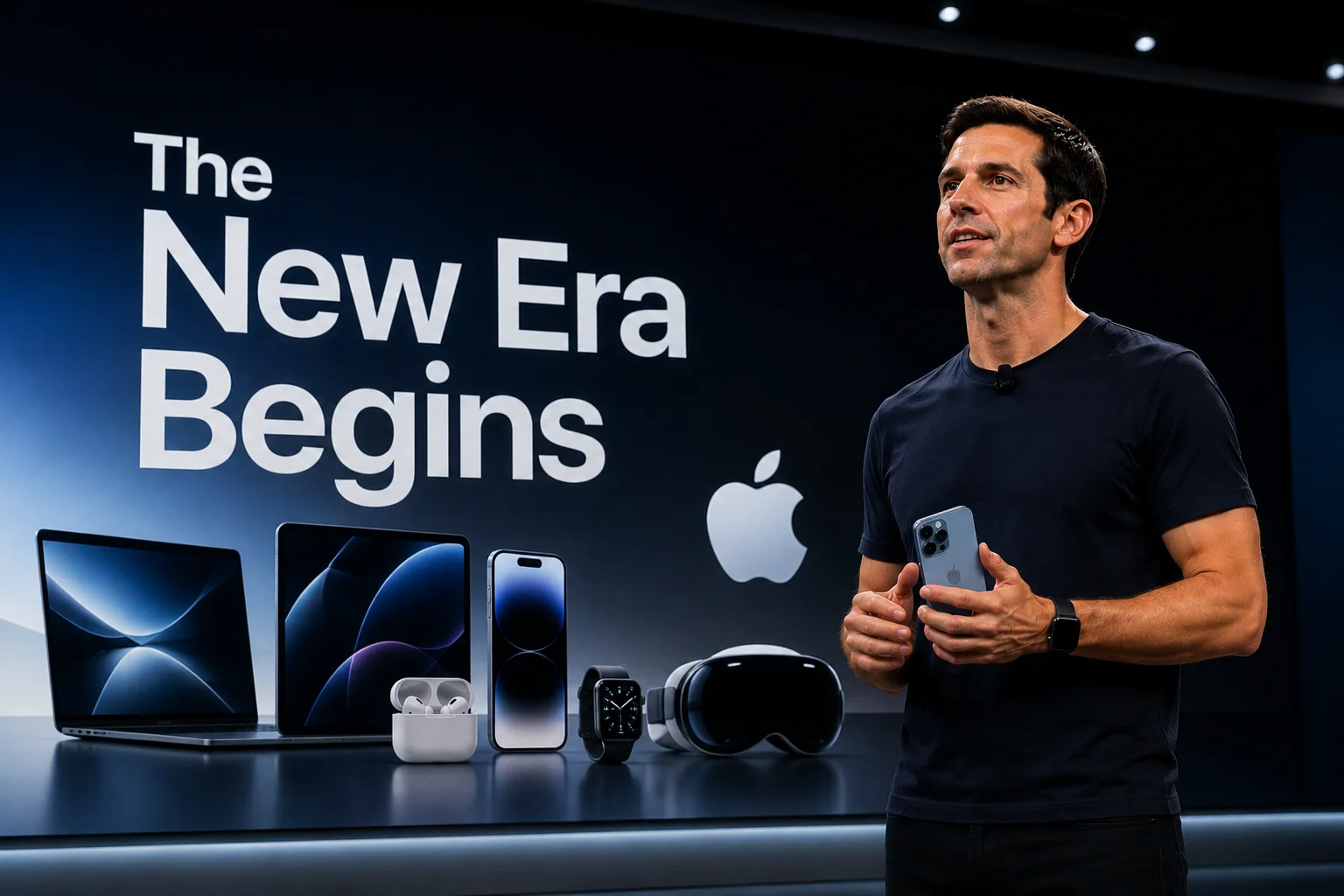
John Ternus Apple CEO: What Changes After Tim Cook?
The John Ternus Apple CEO era has officially begun, marking one of the most important leadership transitions in Apple’s modern history. On September 1, 2026, John Ternus took over as Apple’s chief executive officer, succeeding Tim Cook after 15 years at the helm.
Cook has moved into the role of Executive Chairman, allowing Apple to maintain leadership continuity while giving Ternus the responsibility of guiding the company into its next phase.
The timing is particularly significant. John Ternus Apple CEO leadership begins just before Apple’s major September product launch, putting the new CEO under an unusually bright spotlight from the beginning.
But what does Ternus’s appointment actually mean for Apple?
Will Apple become more focused on artificial intelligence? Could hardware innovation accelerate? Will the company introduce completely new products? And can Ternus maintain Apple’s enormous success while preparing it for a rapidly changing technology industry?
Let’s take a closer look at what could change under Apple’s new CEO.
Who Is John Ternus, Apple’s New CEO?
John Ternus is not an outsider coming into Apple with a completely different philosophy.
He has been part of Apple for more than two decades and has spent much of his career working on the company’s hardware products. Before becoming CEO, Ternus served as Apple’s senior vice president of Hardware Engineering.

His responsibilities included engineering work associated with major Apple products such as the iPhone, iPad, Mac and AirPods. He also played an important role in Apple’s transition to its own Apple silicon chips.
That background is important because it makes John Ternus Apple CEO a very different leadership story from the transition that brought Tim Cook into the role.
Cook was heavily associated with Apple’s operations, supply chain and global business expansion. Ternus comes from the engineering and product-development side of Apple.
That could influence the company’s priorities over the coming years.
Why Tim Cook’s Transition Is So Important
Tim Cook became Apple’s CEO in 2011 following Steve Jobs.
During his leadership, Apple transformed from an already successful technology company into a global technology and services powerhouse.
The company expanded its services business, strengthened its supply chain, grew its international presence and continued developing the iPhone, Mac, iPad, Apple Watch and AirPods ecosystems.
Apple also transitioned the Mac from Intel processors to its own Apple silicon, creating a major strategic advantage in performance and energy efficiency.
Cook’s tenure therefore leaves Ternus with an unusual challenge.
He is not taking over a struggling company that needs to be rescued.
He is taking over one of the world’s most successful technology companies.
The central question for the John Ternus Apple CEO era is therefore not simply how to keep Apple successful.
It is how to create Apple’s next major growth story.
John Ternus Apple CEO: Continuity or a New Direction?
The appointment of Ternus suggests that Apple wants a combination of continuity and evolution.
Because Ternus has spent so long inside Apple, he already understands the company’s culture, product-development process and emphasis on tightly integrated hardware and software.
That means consumers should not expect Apple to suddenly abandon the strategy developed under Cook.
Instead, changes are likely to happen gradually.
The company could place greater emphasis on engineering innovation, artificial intelligence, custom silicon and emerging hardware categories while maintaining the ecosystem and services business that Cook helped expand.
In other words, the John Ternus Apple CEO transition may represent a new chapter rather than a complete reset.
John Ternus AI Strategy Could Define His Leadership
Artificial intelligence may become the biggest test of Ternus’s leadership.
The technology industry has changed dramatically since the launch of modern generative AI. Companies across the sector are competing to build smarter assistants, AI-powered software and new computing experiences.
Apple has entered this race through Apple Intelligence, but its AI progress has attracted significant attention and criticism compared with some competitors.
This makes the John Ternus AI strategy particularly important.
Ternus could push Apple toward deeper integration of AI across its devices.
Instead of treating AI as a separate application, Apple could make it part of the fundamental experience of using an iPhone, Mac, iPad or wearable device.
Potential applications include:
- Smarter Siri
- More personalized recommendations
- AI-assisted photography and video
- Intelligent writing and communication tools
- Automated everyday tasks
- Better on-device processing
- More powerful developer tools
- AI-powered accessibility features
The major challenge will be delivering these capabilities while maintaining Apple’s emphasis on privacy, security and user control.
Could Siri Finally Become a Major AI Assistant?
Siri could become one of the clearest indicators of Apple’s AI direction.
For years, Siri was one of Apple’s most recognizable software features. However, the rapid development of generative AI has raised expectations for what a digital assistant should be able to accomplish.
Users increasingly expect assistants to understand context, remember previous interactions, work across applications and complete multi-step tasks.
The John Ternus Apple CEO era could therefore bring a much more ambitious Siri.
Instead of simply answering questions or performing individual commands, a future Siri could potentially understand what users are trying to accomplish and coordinate actions across Apple’s ecosystem.
That would be a major evolution for Apple’s software strategy.
Apple New CEO 2026 Faces a Major Product Test
The timing of Apple’s leadership transition could hardly be more interesting.
Apple new CEO 2026 takes charge immediately before the company’s major September product cycle.
That means Ternus will have very little time to settle into his new position before the world begins examining Apple’s latest products.
The launch itself may not reveal every detail of his long-term strategy.
Most products introduced during the transition will have been in development for years.
However, investors and consumers will be watching closely for clues about what comes next.
Questions will include:
- Is Apple accelerating AI development?
- Are new hardware categories becoming more important?
- Is Apple pushing its silicon strategy further?
- How quickly will new products reach consumers?
- Will Apple take bigger risks with product design?
The answers may help define the early perception of the John Ternus Apple CEO era.
Will Apple Become More Engineering-Driven?
One of the most interesting possibilities is a stronger engineering focus.
Ternus’s professional background is deeply connected to product engineering.
That could encourage Apple to invest even more heavily in technologies that improve the physical capabilities of its devices.
Areas worth watching include:
Apple Silicon
Apple’s custom chips have become a major competitive advantage.
Future generations will need to deliver greater performance while improving energy efficiency and supporting increasingly demanding AI workloads.
Displays
New display technologies could create opportunities for thinner, lighter and more flexible devices.
Cameras
Computational photography and AI processing could continue changing how Apple approaches smartphone cameras.
Battery Technology
More efficient processors and advances in battery technology could enable thinner devices and longer battery life.
Wearable Technology
Apple Watch, AirPods and future wearable products could become increasingly important parts of Apple’s ecosystem.
For a CEO with Ternus’s background, these areas could receive significant attention.
The Tim Cook Successor Has Another Major Challenge: AI Infrastructure
Building impressive AI features requires more than software.
It requires chips, data centers, computing capacity and efficient models.
This could play directly into Ternus’s experience with Apple’s silicon strategy.
Apple has spent years developing its own processors for the iPhone, iPad and Mac. The company can potentially use that expertise to create devices optimized specifically for AI workloads.
On-device AI could also provide an important advantage.
Rather than sending every request to the cloud, certain AI tasks can potentially be processed directly on the device.
That can improve privacy and reduce dependence on remote computing infrastructure.
The Tim Cook successor will therefore have to balance Apple’s traditional hardware strengths with the enormous infrastructure requirements of modern AI.
What Happens to Apple’s Services Business?
The rise of Ternus does not mean Apple will suddenly move away from services.
Quite the opposite.
Services have become one of the most important components of Apple’s business.
Products such as the App Store, iCloud, Apple Music, Apple TV and other subscription services create recurring revenue while strengthening Apple’s ecosystem.
Ternus is therefore likely to continue building the services business.
However, AI could change how these services work.
Imagine an Apple ecosystem where an intelligent assistant can search information, manage files, interact with applications, recommend content and perform tasks across multiple services.
That could make Apple’s ecosystem considerably more valuable.
Apple Future: New Products Could Become More Important
The Apple future under Ternus could depend heavily on products beyond the iPhone.
The iPhone remains Apple’s most important consumer product, but the company eventually needs new categories capable of creating significant growth.
Several areas could become strategically important.

Foldable Devices
A foldable iPhone could potentially create an entirely new premium category while challenging Apple’s traditional smartphone design.
Spatial Computing
Apple Vision Pro represents Apple’s attempt to establish a new computing platform.
The challenge is making spatial computing smaller, more affordable and useful enough for mainstream consumers.
Wearables
AirPods and Apple Watch already demonstrate Apple’s ability to create successful products around the iPhone ecosystem.
Future wearable devices could take that concept further.
AI Hardware
The biggest opportunity could ultimately be a new type of device designed around AI rather than traditional smartphone interaction.
If Apple creates such a product, Ternus’s engineering background could become extremely valuable.
Supply Chain Will Still Matter
Even the most innovative product means little if Apple cannot manufacture it efficiently.
Tim Cook built much of his reputation around operations and supply-chain management.
Ternus will therefore inherit one of the world’s most sophisticated manufacturing networks.
Apple has also been working to diversify its production beyond China, with countries such as India and Vietnam becoming increasingly important to its manufacturing strategy.
The new CEO will need to maintain a delicate balance between cost, quality, production capacity, geopolitical risks and product availability.
This is one area where Cook’s experience could remain valuable even after moving away from the CEO role.
Tim Cook Will Not Completely Disappear
The transition does not mean Tim Cook is leaving Apple.
As Executive Chairman, Cook will remain involved with the company and can provide continuity during the leadership change.
This is particularly useful because Ternus will be navigating challenges that require both technical understanding and global business experience.
The arrangement could allow Ternus to focus heavily on products, technology and long-term strategy, while Cook continues contributing his experience at the board and external-policy level.
For Apple, this creates a relatively unusual combination of new leadership with strong institutional continuity.
What Could Go Wrong for John Ternus?
The John Ternus Apple CEO transition also comes with significant risks.
The biggest challenge may be Apple’s own success.
When a company already generates enormous revenue from established products, taking major risks can be difficult.
But technology does not stand still.
AI is changing the way people interact with computers. New companies are creating new products and services. Consumer expectations are evolving quickly.
Ternus will therefore have to answer a difficult question:
When should Apple protect its existing business, and when should it disrupt itself?
Moving too slowly could allow competitors to establish new technology platforms.
Moving too aggressively could damage the product quality and ecosystem that made Apple successful.
Finding the right balance may be Ternus’s most important leadership challenge.
What Consumers Should Expect From the Ternus Era
Consumers should not expect Apple to become completely different overnight.

The iPhone will remain central to the company’s strategy.
The Apple ecosystem will continue to connect devices and services.
Privacy will remain an important part of Apple’s identity.
But over the next several years, users could see a gradual transformation.
Apple may deliver smarter devices, deeper AI integration, more powerful chips, new hardware categories and more intelligent software experiences.
These changes could become the defining characteristics of the John Ternus Apple CEO era.
5 Major Changes to Watch Under John Ternus
1. More Aggressive AI Development
Apple will need to close the gap with the fastest-moving AI competitors.
2. Stronger Hardware Innovation
Ternus’s engineering background could encourage greater investment in new hardware technologies.
3. New Product Categories
Foldables, spatial computing and next-generation wearables could become increasingly important.
4. Deeper Apple Silicon Integration
Custom chips could become even more central to Apple’s AI and device strategy.
5. A More Intelligent Apple Ecosystem
AI could connect Apple’s hardware and services in ways that were previously difficult to achieve.
John Ternus Apple CEO: What Happens Next?
The arrival of John Ternus Apple CEO marks the beginning of an important new chapter.
Tim Cook leaves behind an Apple that is larger, richer and more diversified than the company he inherited in 2011.
Ternus now has a different mission.
He must prepare Apple for the next decade.
That means competing in artificial intelligence, continuing to develop custom silicon, creating exciting hardware and potentially establishing entirely new product categories.
His engineering background gives him a unique understanding of Apple’s greatest strength: the ability to combine hardware, software and silicon into one integrated experience.
But technical expertise alone will not guarantee success.
Ternus will also need to make difficult decisions about risk, competition, pricing, partnerships and the future of Apple’s ecosystem.
The first major clues will come from Apple’s September product cycle.
The bigger story, however, will unfold over the next several years.
Tim Cook built and expanded Apple’s modern business. John Ternus now has the opportunity to define what Apple becomes after it.
If he can combine Apple’s legendary product design with competitive AI and genuinely new computing experiences, the John Ternus Apple CEO era could become one of the company’s most transformative periods yet.
Frequently Asked Questions About John Ternus Apple CEO
1. Who is John Ternus?
John Ternus is Apple’s former senior vice president of Hardware Engineering and the company’s new CEO. He has worked at Apple since 2001 and has been closely involved with the engineering of major Apple products.
2. When did John Ternus become Apple CEO?
John Ternus officially became Apple’s CEO on September 1, 2026, succeeding Tim Cook.
3. Who is Tim Cook’s successor at Apple?
John Ternus is Tim Cook’s successor as Apple’s chief executive officer.
4. Will John Ternus change Apple’s AI strategy?
AI is expected to be one of the most important areas of Ternus’s leadership. His hardware and silicon experience could help Apple integrate AI more deeply into its devices.
5. Will Tim Cook leave Apple?
No. Tim Cook has moved from CEO to Executive Chairman, allowing him to remain involved with Apple while Ternus leads the company.
6. What will happen to the iPhone under John Ternus?
The iPhone is expected to remain central to Apple’s business. However, future iPhones could place greater emphasis on AI, custom silicon, new designs and advanced computing capabilities.
7. Could Apple launch new products under Ternus?
Potentially. Foldable devices, spatial computing, wearables and AI-focused products are among the areas that could influence Apple’s next generation of products.
8. Why is John Ternus important to Apple’s future?
His extensive engineering experience gives him deep knowledge of Apple’s hardware, silicon and product-development processes. That could become particularly valuable as Apple competes in AI and develops new computing platforms.
Conclusion
The John Ternus Apple CEO transition is more than a change in Apple’s leadership.
It represents the beginning of a new phase for a company facing some of the biggest technological changes in its history.
Ternus inherits Tim Cook’s enormous achievements, but he also inherits the pressure to create Apple’s next major innovation story.
The most important questions are now about AI, hardware, Apple silicon, new products and the future of computing.
For consumers, investors and technology enthusiasts, the next few years could reveal whether Ternus becomes the leader who simply maintains Apple’s extraordinary momentum or the CEO who takes the company into an entirely new era.
Apple’s next chapter has officially begun.
Check out www.techmindspro.com for posts related to tech world