
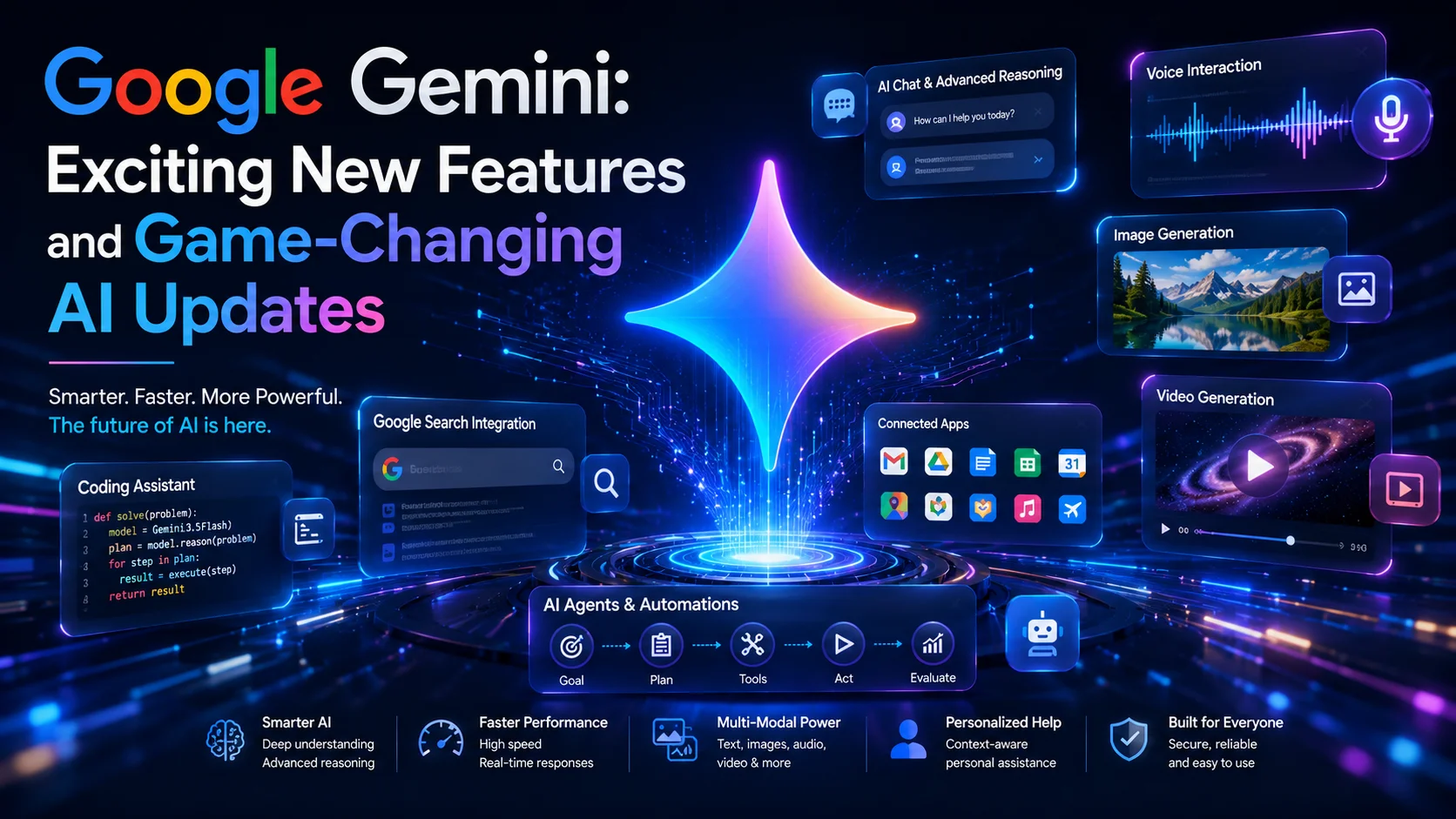
Google Gemini: Exciting New Features and Game-Changing AI Updates with 10 FAQs
Google Gemini has evolved rapidly from a conversational chatbot into a broader AI assistant capable of handling research, writing, coding, image creation, voice interactions, connected applications, and increasingly complex tasks on behalf of users. The latest updates in 2026 show that Google is moving Gemini toward a more proactive and agentic experience rather than limiting it to simple question-and-answer conversations.
Google’s recent announcements include new Gemini models, Gemini Spark, Gemini Live productivity features, expanded Connected Apps, Gemini in Chrome, multimodal creation tools, and deeper integration across Google’s ecosystem. Google also announced in August 2026 that the Gemini app had surpassed 1 billion monthly active users, demonstrating how quickly its AI platform has expanded.
For users who want a modern AI assistant for everyday productivity, creative work, research, and automation, these updates make Gemini considerably more capable than earlier versions.
What Is Google Gemini?
Google Gemini is Google’s family of generative AI models and applications designed to understand and work with different types of information, including text, images, audio, video, files, and increasingly complex real-world tasks.

Unlike traditional software that generally waits for a specific command, newer Gemini experiences are designed to understand goals, use connected tools, perform multiple steps, and return useful results. This shift toward agentic AI is one of the most important updates in Google’s current strategy.
Gemini is available through the Gemini app, Google Search, Chrome, Android, Google Workspace-related experiences, developer platforms, and other Google products. The exact features available to users can vary according to country, account type, subscription, device, and rollout status.
Latest Google Gemini Updates in 2026
The biggest updates to Gemini during 2026 have focused on five major areas: AI reasoning, agentic capabilities, personalization, multimodal creation, and integration with external services.
Google introduced Gemini 3.5 Flash, expanded Gemini Spark, introduced Gemini Omni, improved Gemini Live, added more Connected Apps, and expanded Gemini’s presence across products such as Chrome and Search.
These updates indicate a clear direction: Google wants Gemini to become an AI assistant that can not only answer questions but also help users accomplish tasks.
Gemini 3.5 Flash: Faster and More Capable AI
One of the major updates announced at Google I/O 2026 was Gemini 3.5 Flash. Google describes it as a model combining frontier-level intelligence with fast action, particularly for agentic workflows, coding, and complex tasks.
The focus is not simply on generating longer answers. The newer AI model is designed to perform more effectively when a task requires several steps or when the user expects the system to work with tools and information.

For developers, this is particularly important because faster reasoning can make agent-based applications more practical. For everyday users, it means Gemini can potentially handle more complicated requests without requiring the user to divide everything into small instructions.
Google has also continued expanding its Flash model family, with July updates including Gemini 3.6 Flash and Gemini 3.5 Flash-Lite.
Gemini Spark: Moving From Chatbot to AI Agent
Perhaps the most significant change to Gemini is Gemini Spark.
Traditional chatbot-style AI waits for a user to ask a question. Spark is designed around a different concept: users can give it tasks, skills, and schedules so that it can work more proactively.

Google describes Spark as a personal AI agent that can work in the background and interact with services such as Gmail, Docs, and Sheets. In India, Google announced Spark for Google AI Pro subscribers, expanding the agentic experience to more users.
Recent Spark updates have added more Google Workspace actions, including editing documents, spreadsheets, and presentations, reading comments, adding images, and refining shared files. Spark has also gained support for additional third-party Connected Apps.
This makes Gemini increasingly useful for repetitive work. Instead of simply asking an AI system what to do, users can increasingly ask it to help perform the work itself.
Gemini Live Gets More Powerful
Gemini Live has also received important updates.
Google’s August 26, 2026 announcement introduced new productivity capabilities for Gemini Live, including Personal Intelligence, Daily Brief, Spark integration, and hands-free inbox management.

The objective is to make voice interaction more useful for real-world productivity. Instead of treating voice as only another way to ask questions, Gemini can use conversation as a way to organize tasks and information.
This is an important development for conversational AI because people can communicate naturally instead of constructing detailed written prompts.
For example, a user could talk through their schedule, ask for help organizing ideas, summarize important messages, or work through a multi-step task. These updates bring Gemini closer to the idea of a digital assistant that understands context rather than merely responding to isolated questions.
Personal Intelligence Makes Gemini More Personalized
Another important direction for Gemini is personalization.
Google has been developing Personal Intelligence, which is intended to make responses more relevant by connecting Gemini with information and services that users choose to make available.
The concept is straightforward: an AI assistant can become more useful when it understands the user’s context, preferences, documents, and connected services.
However, personalization also makes privacy and permission controls increasingly important. Users should understand which services are connected and what information an AI system can access before enabling advanced features.
As these updates continue, personalization is likely to become one of the defining differences between a general chatbot and a personal AI assistant.
Gemini Connected Apps Expand
Google is also expanding the number of services that can work with Gemini.
In August 2026, Google announced new Connected Apps and services covering productivity, creativity, local experiences, entertainment, music, home services, and other categories. The announced integrations include services such as Granola, Otter.ai, Wix, Fever, GetYourGuide, Localiza, OpenTable in the UK, Ticketmaster, iHeartRadio, Pandora, Angi, Thumbtack, and Zocdoc.
This is an important AI development because an assistant becomes more useful when it can interact with external services.
Instead of switching between multiple applications, users can increasingly use Gemini as a central interface for different tasks.
The Connected Apps updates also show Google’s broader strategy: Gemini is becoming an orchestration layer that can work across different tools.
Gemini in Chrome
Google has also brought Gemini deeper into Chrome.
Recent updates to Gemini in Chrome on Android allow users to summarize long articles, ask questions about webpages, and connect Gemini with Google services such as Calendar and Keep. Users can also create and customize images with Nano Banana.
For eligible AI Pro and AI Ultra subscribers in the United States, Google has introduced agentic AI capabilities through auto browse.
Auto browse is designed to help with certain online tasks, such as organizing travel or handling repetitive online activities. Google says the feature is built with security considerations and can request confirmation before completing certain sensitive actions.
This is another example of the transition from informational AI to action-oriented AI.
Gemini Omni and Multimodal Creation
Google introduced Gemini Omni at I/O 2026 as a new model family designed to generate different types of output from different forms of input.
The first model, Gemini Omni Flash, began with video generation and is designed around multimodal understanding and creation. Google says users can combine images, audio, video, and text as inputs and create video outputs grounded in Gemini’s understanding.
This is significant because multimodal AI is becoming increasingly important.
Instead of treating text, images, audio, and video as separate technologies, modern Gemini models are increasingly designed to work across these formats.
For content creators, marketers, educators, and businesses, these updates could make it easier to move from an idea to a complete piece of multimedia content.
Gemini Image Generation Gets More Flexible
Image generation remains another major area of development for Gemini.
Google’s 2026 updates include more personalized image creation and the ability to add a user’s avatar to generated images without requiring the user to upload an image every time.
Google has also highlighted the continued popularity of its Nano Banana image-generation technology. At I/O 2026, Google said more than 50 billion images had been generated using its Nano Banana models.
For users, the practical benefit is that AI image generation is becoming more conversational and customizable.
Instead of writing a single prompt and accepting the first result, users can increasingly refine an image through a conversation with Gemini.
Gemini and Google Search
Google is also integrating more advanced AI capabilities into Search.
At I/O 2026, Google announced Gemini 3.5 Flash as the default model in AI Mode for Search and introduced a more intelligent Search interface capable of accepting different types of inputs, including text, images, files, videos, and Chrome tabs.
This represents a major change in how people may interact with Search.
Instead of entering a short keyword phrase, users can describe a complicated problem and provide multiple forms of context. Gemini can then help interpret that information.
Google is also moving toward agentic Search experiences, including information agents that can work in the background and personalized experiences for longer-running tasks.
These updates could make Search more useful for research and complex planning, although users should still verify important information.
Gemini Reaches More Than 1 Billion Monthly Users
One of the biggest indicators of Gemini’s growth came in August 2026.
Google announced that the Gemini app had surpassed 1 billion monthly active users. Google also reported that 63% of users now talk directly to Gemini, while one in five Gemini Live interactions goes beyond voice through features such as camera input and screen sharing.
These figures demonstrate how quickly conversational AI has moved into everyday use.
The growth also highlights why Google’s continued updates to voice, vision, image generation, automation, and connected applications matter. Gemini is no longer positioned simply as an experimental chatbot; it is becoming a major consumer AI platform.
Gemini Live, Camera and Screen Sharing
Multimodal interaction is another important part of the modern Gemini experience.
With camera and screen-sharing capabilities, users can give the AI additional visual context. This can be useful when explaining something that is difficult to describe using text alone.
For example, a user may want help understanding something displayed on a screen, identifying information in a document, or discussing an object visible through a camera.
Google’s reported usage data shows that these capabilities are already being used at significant scale.
The broader trend is clear: future AI assistants are likely to understand not only what users type but also what they see, hear, and interact with.
Gemini for Productivity
Productivity is one of the strongest use cases for Gemini.
Users can employ the AI assistant for tasks such as:
- Writing and rewriting content
- Summarizing documents
- Brainstorming ideas
- Researching topics
- Analyzing files
- Creating presentations
- Working with spreadsheets
- Generating images
- Organizing information
- Managing certain connected tasks
The newest updates extend this capability by allowing Gemini to work more directly with applications and services.
This makes the assistant more useful for students, professionals, creators, small businesses, and teams that frequently deal with information-heavy workflows.
Gemini for Coding and Development
Coding continues to be another major area for Gemini.
Google has specifically emphasized improvements in coding and long-horizon tasks with Gemini 3.5 Flash.
Modern coding AI can help developers understand existing code, generate new code, identify bugs, explain technical concepts, and prototype applications.
The more important change is the movement toward agentic development. Instead of asking an AI model for one code snippet at a time, developers can increasingly provide a goal and allow the system to work through multiple stages.
These updates are particularly relevant for software teams because they can reduce repetitive development work while allowing developers to spend more time reviewing architecture, testing, security, and product decisions.
What Makes the New Gemini Different?
Students can also benefit from the newer Gemini features.
The AI assistant can help explain difficult concepts, summarize information, analyze documents, brainstorm project ideas, and organize study material.
Google reported that 38% of school-related Gemini requests include an attachment, showing that students are already using files as part of their interactions.
However, students should use AI as a learning assistant rather than blindly copying generated answers. Verifying facts, understanding the reasoning, and completing original work remain important.
The latest updates make Gemini more capable, but better capability does not eliminate the need for human judgment.
Gemini Plans and Usage Limits
Not every Gemini feature is available to every user.
Google provides different levels of access depending on the user’s account and Google AI subscription. Some advanced models and features have higher usage limits or are restricted to eligible plans.
Google’s current documentation states that Gemini Apps use compute-based limits that depend on factors such as prompt complexity, model selection, features used, and conversation length. Limits can refresh periodically, while weekly limits may also apply.
This means users should check the current availability of individual features rather than assuming every Gemini capability is included in every plan.
Because Google frequently releases updates, availability can also change over time.
What Makes the New Gemini Different?
The most important difference is the move from answers to actions.
Earlier chatbot experiences primarily focused on generating responses. Modern Gemini is increasingly designed to understand goals, access connected services, use tools, perform multiple steps, and provide proactive assistance.
This is the central shift happening across today’s AI industry.
Gemini Spark, Connected Apps, Gemini Live, Chrome agentic capabilities, and Search agents all point in the same direction. The user increasingly gives the system an objective rather than a sequence of individual instructions.
These updates could eventually change how people interact with software itself.
Key Benefits of Google Gemini
The latest Gemini ecosystem offers several important advantages:
1. Multimodal AI
Gemini can work across text, images, audio, video, files, and other forms of information.
2. Strong Google Integration
The AI assistant can connect with Google services and an expanding selection of external applications.
3. Agentic Capabilities
Gemini is increasingly capable of completing multi-step tasks instead of simply answering questions.
4. Voice-Based Interaction
Gemini Live makes conversational interaction more natural and useful for productivity.
5. Creative Tools
Image and video generation provide additional ways to turn ideas into content.
6. Personalization
Personal Intelligence and connected services can make responses more relevant to individual users.
7. Developer Support
The latest models provide capabilities for coding, agents, and complex workflows.
Limitations to Consider
Despite the rapid updates, Gemini is not perfect.
AI-generated responses can still contain incorrect information, misunderstand user intent, or produce results that require verification. Agentic features can also involve permissions and connected services, so users should understand what an AI assistant is allowed to access or change.
Feature availability can vary by region, language, device, account, and subscription.
Google’s own documentation also notes that Gemini features and usage limits can differ according to the model and tools being used.
Therefore, users should treat Gemini as a powerful assistant rather than an infallible source of truth.
Google Gemini vs Traditional AI Assistants
The direction of Google’s Gemini development is becoming increasingly clear.
The company is moving toward a future where AI assistants can understand context, remember useful information with appropriate permissions, use external tools, operate across applications, create multimedia content, and perform tasks with less supervision.
The next generation of updates will likely focus on better reasoning, stronger agents, more natural voice interaction, improved personalization, deeper application integration, and more reliable task execution.
The introduction of Gemini Spark and the expansion of Connected Apps suggest that Google sees agentic AI as a major part of Gemini’s future.
Google Gemini vs Traditional AI Assistants
Traditional digital assistants generally respond to simple commands such as setting reminders, answering basic questions, or controlling device functions.
Modern Gemini is designed to go considerably further.
A traditional assistant may answer a question. A modern AI assistant can potentially research information, interpret files, generate content, interact with applications, and work through a multi-step objective.
That does not mean every task can be fully automated. Instead, the latest updates are gradually expanding the range of tasks where users can delegate parts of their workflow.
How to Get the Most From Gemini
To get better results from Gemini, users should provide clear goals and useful context.
Instead of writing:
“Write something about marketing.”
A stronger prompt could be:
“Create a 1,000-word beginner-friendly marketing guide for small businesses, include five practical strategies, examples, and a short conclusion.”
For complex tasks, users should also explain the desired output format, audience, constraints, and priorities.
As AI systems become more capable, good instructions remain valuable.
The latest updates do not remove the importance of prompting. Instead, they make it possible to give Gemini broader objectives and allow the system to determine more of the intermediate steps.
Frequently Asked Questions About Google Gemini
What is Google Gemini?
Google Gemini is Google’s family of generative AI models and applications. It can work with text, images, audio, video, files, and various connected services.
What is the latest Google Gemini model?
Google’s 2026 announcements include Gemini 3.5 Flash, along with newer Flash-family updates such as Google Gemini 3.6 Flash and Google Gemini 3.5 Flash-Lite. Availability can vary by product and user.
What is Gemini Spark?
Gemini Spark is Google’s agentic AI experience designed to help users perform tasks, create skills, use schedules, and work with connected services.
Can Google Gemini work with other apps?
Yes. Google has been expanding Connected Apps, allowing Gemini to work with a growing range of Google and third-party services.
Does Google Gemini generate images?
Yes. Gemini supports AI image generation and editing, including newer personalized image experiences and Nano Banana capabilities.
Can Google Gemini understand images and video?
Gemini is designed to be multimodal, meaning it can process multiple types of information. Google is also expanding multimodal experiences through Google Gemini Omni and Gemini Live.
Can Google Gemini help with coding?
Yes. Coding is a major focus of Google’s latest AI models, particularly Gemini 3.5 Flash and Google’s agent-oriented developer tools.
Is Google Gemini free?
Google Gemini has free access options, but some advanced models, features, and higher usage limits require eligible Google AI subscriptions.
Is Google Gemini available in India?
Yes. Google has specifically announced Google Gemini Spark availability for Google AI Pro subscribers in India, with rollout timing depending on the feature.
Is Google Gemini better than older AI assistants?
Google Gemini’s newest updates give it broader multimodal, agentic, productivity, and connected-app capabilities. Whether it is better depends on the specific task and user’s preferred ecosystem.
Final Thoughts
Google Gemini is rapidly changing from a conversational chatbot into a broader AI platform that can understand information, create content, interact with applications, and increasingly perform tasks on a user’s behalf.
The biggest updates in 2026 are not limited to a single new model. They represent a larger transformation across Google Gemini’s ecosystem. Google Gemini 3.5 Flash brings faster and more capable reasoning, Google Gemini Spark introduces proactive agentic assistance, Google Gemini Live adds stronger voice productivity, Connected Apps expand what Google Gemini can access, and Google Gemini in Chrome and Search bring AI assistance closer to everyday web activity.
With more than 1 billion monthly users, Google Gemini has become one of the world’s largest consumer AI platforms.
The most important takeaway is that Google’s vision for Google Gemini is no longer simply about answering questions. The future is increasingly about an AI assistant that understands context, connects to useful tools, handles multiple steps, and helps users accomplish real-world goals.
As Google continues releasing new updates, Google Gemini is likely to become an even more integrated part of Search, Android, Chrome, productivity software, creative workflows, and everyday digital life.
Computer Engineering terminologies Part 1
Check out www.globaledutechpro.com for Educational posts