
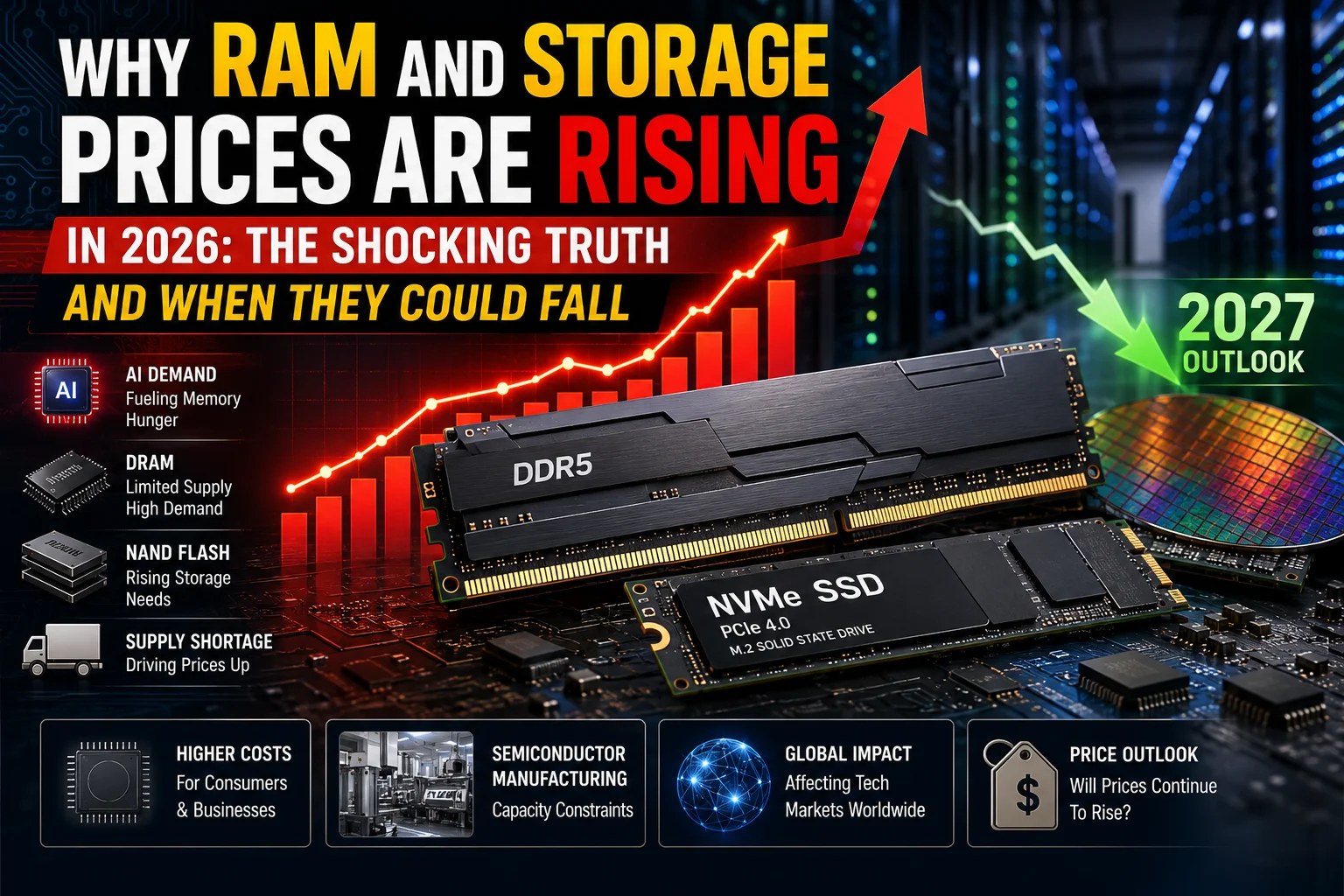
Why RAM and Storage Prices Are Rising: The Shocking Truth and When They Could Fall
The price of computer memory and Storage has become a major concern for PC buyers, laptop users, smartphone manufacturers, gamers, and businesses in 2026. After years of relatively affordable memory, the market has entered a very different phase, with RAM Prices and Storage Prices moving higher because of strong AI demand, limited manufacturing capacity, and changing priorities among major semiconductor manufacturers.
The biggest factor behind the current situation is the explosive growth of artificial intelligence. Modern AI data centers require enormous quantities of high-performance memory, including HBM, server DRAM, and enterprise SSDs. Manufacturers such as Samsung, SK hynix, and Micron are therefore allocating significant production capacity toward products used in AI infrastructure.
This has created an important problem for consumers. The same semiconductor manufacturing resources are being used to produce different types of memory, and when manufacturers prioritize higher-margin AI products, conventional RAM and Storage products can become comparatively harder to obtain.

According to TrendForce, conventional DRAM contract Prices were expected to increase by 13–18% quarter over quarter in Q3 2026, while NAND Flash contract Prices were projected to rise by around 10–15%.
So, why is this happening, and more importantly, when can consumers expect RAM and Storage Prices to come down?
The Main Reason Behind Rising RAM Prices
The current RAM market is being heavily influenced by artificial intelligence infrastructure.
Traditional computers use DRAM for applications, operating systems, games, and general computing. Servers use much larger quantities of memory, while AI systems require specialized high-bandwidth memory and large amounts of conventional DRAM.
AI data centers are being built at an unprecedented scale. Companies are investing billions of dollars in servers, GPUs, networking equipment, and data-center infrastructure. These systems require huge amounts of memory.
As AI demand increases, semiconductor manufacturers have an incentive to dedicate more production resources to HBM and server memory, because these products generally provide stronger margins than traditional consumer memory.
This creates a supply squeeze for conventional RAM.
TrendForce reported that the DRAM market remained extremely tight during Q3 2026, with AI server demand continuing to support memory demand even though consumer demand had weakened.

The result is a difficult combination:
- AI demand is increasing
- Server memory demand is increasing
- HBM production is receiving greater priority
- Consumer memory demand remains significant
- Manufacturing capacity cannot expand instantly
Together, these factors are keeping RAM Prices elevated.
How AI Is Changing the Memory Market
Artificial intelligence is not simply increasing demand for GPUs.
AI systems also require enormous amounts of memory and Storage.
Large language models need memory for model parameters, intermediate calculations, caching, and data processing. AI servers can contain extremely large quantities of high-performance memory compared with conventional desktop PCs.
The rapid expansion of AI infrastructure has therefore created a new hierarchy in the memory market.
At the highest end is HBM, followed by various forms of server DRAM and increasingly sophisticated Storage solutions.
This is important because semiconductor factories cannot simply switch production from one memory product to another overnight.
Manufacturing processes, equipment, wafer capacity, packaging technology, qualification requirements, and customer contracts all influence what can be produced.
That means increasing consumer demand does not automatically result in additional RAM being available.
Why Storage Prices Are Also Increasing
The Storage market is facing many of the same pressures.
Modern SSDs rely on NAND Flash, and NAND is also being increasingly used in data centers.
AI systems generate and process enormous quantities of information. Training data, model checkpoints, datasets, logs, inference data, application data, and AI-generated content all require Storage.
Enterprise SSD demand has therefore become an increasingly important part of the NAND market.
TrendForce reported on September 1, 2026, that revenue for the top five enterprise SSD suppliers reached approximately $37.59 billion in Q2 2026, representing a 103.6% quarter-over-quarter increase. The company also expects enterprise SSD demand to remain elevated in Q3 because of generative AI services and data-center deployments.
This helps explain why consumer SSD Prices are not falling as quickly as many buyers expected.
Manufacturers Are Prioritizing High-Value Products
One of the most important factors affecting RAM and Storage Prices is manufacturer strategy.
Companies producing memory have limited resources. They must decide how to allocate production capacity among different products.
When AI-related products become more profitable, manufacturers naturally have an incentive to prioritize them.
This does not mean conventional RAM or Storage production has stopped.
Instead, it means that production capacity is being allocated differently.
The shift is particularly important for DRAM because HBM production uses advanced manufacturing and packaging resources. As AI companies purchase more HBM, the supply available for conventional DRAM can become tighter.
TrendForce has noted that continued HBM capacity allocation and strong AI server demand are expected to keep DRAM supply constrained into 2027.
Why DDR4 Prices Can Behave Differently From DDR5
Another interesting part of the current market is the difference between memory generations.
Consumers often assume that older RAM automatically becomes cheaper.
That is not always true.
When manufacturers reduce production of an older generation, supply can become tighter even if the technology itself is outdated.
This can create an unusual situation where an older memory standard becomes surprisingly expensive.
DDR4 is a good example.
Manufacturers increasingly focus on newer memory technologies and higher-value products. If production of older memory decreases faster than demand, Prices can remain high.
Therefore, consumers should not assume that buying older RAM will always be the cheapest solution.
Why SSD Prices Are Not Moving in One Direction
The Storage market is more complicated than simply saying that SSD Prices are increasing.
Different NAND products can behave differently depending on capacity, technology, application, and supply conditions.
For example, enterprise SSD demand can remain strong while some consumer NAND products experience weaker demand.
TrendForce’s latest research indicates that some NAND segments are entering a consolidation phase, while supply shortages remain in specific areas.
This means a 1TB consumer SSD, a high-end 2TB PCIe 5.0 SSD, and an enterprise data-center SSD may experience very different pricing trends.
Consumers should therefore look at the specific Storage category rather than assuming that the entire NAND market is moving identically.
Will RAM and Storage Prices Keep Rising?
The short answer is: not necessarily at the same rate.
The market is already showing signs that the pace of increases can vary.
TrendForce expected conventional DRAM Prices to rise by 13–18% in Q3 2026, but also noted that consumer affordability limits and weaker consumer demand could moderate future increases.
In other words, there is a difference between Prices continuing to remain high and Prices continuing to rise rapidly.
The first scenario can persist for a long time.
The second scenario depends heavily on supply expansion and demand.
For consumers, this distinction is extremely important.
RAM Prices may stop increasing rapidly before they actually return to the low levels seen during previous memory cycles.
When Can RAM Prices Come Down?
This is the question most PC buyers want answered.
Unfortunately, there is no guaranteed date.
However, current industry forecasts suggest that the DRAM market could remain relatively tight through 2027 because AI infrastructure continues to consume substantial memory capacity.
TrendForce’s July 2026 outlook stated that AI would remain the primary driver of memory demand in 2027 and that DRAM supply would remain constrained because of HBM capacity allocation and continued AI server demand.
That means a significant decline in RAM Prices may take longer than consumers hope.
A meaningful reduction would likely require several things to happen simultaneously:
- New manufacturing capacity must come online.
- HBM demand must become more balanced.
- AI server investment must slow or stabilize.
- Conventional DRAM supply must increase.
- Consumer electronics demand must remain weak enough to prevent another shortage.
- Manufacturers must rebuild inventories.
Until these conditions develop, RAM Prices may remain relatively elevated.
When Can Storage Prices Come Down?
The outlook for Storage is somewhat more encouraging.
Unlike DRAM, NAND Flash could see a gradual improvement in supply conditions as additional production capacity becomes available.
TrendForce expects NAND Flash supply conditions to become looser during the second half of 2027, assuming production growth continues and consumer electronics demand remains relatively weak.
This does not mean every SSD will suddenly become cheap in 2027.
Instead, it means the supply-demand balance could become more favorable to buyers.
The timing will depend on:
- NAND production growth
- AI data-center demand
- Enterprise SSD demand
- Consumer PC demand
- Smartphone shipments
- Inventory levels
- New manufacturing capacity
- Technology transitions
Therefore, consumers looking for lower Storage Prices may have a better chance of seeing meaningful relief in late 2027 than in the immediate future.
Why 2027 Could Become an Important Year
The memory market works in cycles.
When Prices become high, manufacturers eventually have an incentive to invest in additional production.
However, semiconductor manufacturing capacity takes years to plan, build, qualify, and bring online.
That is why today’s shortage cannot necessarily be solved by simply increasing production next month.
Several manufacturers are already investing heavily in future capacity.
SK hynix, for example, announced major investments aimed at expanding its AI-memory capabilities. Reuters reported in August 2026 that the company expects the memory shortage to persist toward 2030 and has committed substantial investment through 2031.
This highlights an important reality: AI may keep memory demand structurally higher for years rather than creating only a temporary spike.
Could AI Eventually Cause RAM Prices to Fall?
Yes, but indirectly.
AI is currently one of the main reasons memory demand is strong.
However, the same AI boom is also encouraging manufacturers to expand capacity.
If enough new production becomes available, the market could eventually move from shortage to balance.

Once supply grows faster than demand, competition among manufacturers can increase.
That is normally when memory Prices begin to fall.
The problem is timing.
If AI demand grows faster than new production, additional capacity may simply be absorbed by new AI infrastructure.
In that case, Prices could remain high despite increasing production.
What Could Cause RAM Prices to Fall Quickly?
A sudden decline is possible, although it would require a significant change in market conditions.
Several events could trigger a sharper correction.
1. AI Investment Slows
If cloud providers and technology companies reduce AI infrastructure spending, demand for HBM and server memory could weaken.
That could release manufacturing capacity toward conventional products.
2. New Production Capacity Arrives
If new factories and production lines begin producing memory at scale, supply could increase substantially.
3. Consumer Electronics Demand Weakens
Lower demand for PCs and smartphones can reduce memory consumption.
Although this is bad news for electronics manufacturers, it can eventually create downward pressure on component Prices.
4. Memory Inventory Builds Up
If manufacturers produce more memory than customers need, inventories begin increasing.
Once inventories become excessive, suppliers may reduce Prices to stimulate demand.
5. Competition Increases
New competitors and additional production capacity can increase competition.
This could be particularly important in the NAND market.
Why Storage May Recover Before RAM
There is a strong possibility that Storage Prices will normalize before conventional RAM Prices.
The reason is the different supply-demand structure.
NAND manufacturers can increase bit output through technology transitions and capacity improvements. TrendForce expects NAND supply growth to outpace demand growth in 2027, gradually easing supply constraints during the second half of that year.
DRAM faces a more complicated situation because manufacturers continue allocating capacity toward HBM and AI-related applications.
Therefore, consumers could potentially see Storage Prices stabilize or decline before RAM Prices experience a major correction.
Should You Buy RAM or Storage Now?
For consumers, the best strategy depends on whether the upgrade is necessary.
If you urgently need additional RAM for work, gaming, software development, video editing, or other demanding applications, waiting indefinitely may not make sense.
The same applies to Storage.
If your existing SSD is almost full, replacing it can be more important than trying to predict the bottom of the market.
However, buyers who do not need an immediate upgrade should avoid purchasing simply because they fear Prices will rise forever.
Memory markets are cyclical.
Even when Prices remain high for an extended period, market conditions can eventually change.
How Consumers Can Save Money During High Memory Prices
There are several practical ways to reduce the impact of high RAM and Storage Prices.
Buy Only the Capacity You Need
Do not automatically purchase the largest available memory configuration.
For many users, a properly configured system can deliver excellent performance without excessive RAM.
Compare Different SSD Categories
A premium PCIe 5.0 SSD is not necessary for every computer.
For many users, a good PCIe 4.0 SSD provides an excellent balance between performance and cost.
Watch Discounts Rather Than Waiting for the Entire Market to Collapse
Retail Prices can temporarily fall even when wholesale memory Prices remain high.
Promotional sales, clearance stock, and retailer competition can therefore create buying opportunities.
Consider Total System Cost
When upgrading a PC, look at the complete system rather than focusing only on individual component Prices.
Sometimes spending slightly more on RAM today can extend a system’s useful life and avoid another upgrade later.
What About Laptop and Smartphone Prices?
Higher memory component Prices can eventually affect the Prices of complete devices.
Manufacturers purchase RAM and Storage in large quantities. If component costs increase significantly, they have several choices:
- Increase product Prices
- Reduce specifications
- Absorb lower profit margins
- Offer fewer high-capacity configurations
- Change suppliers
This means the current memory shortage could eventually affect laptops, smartphones, gaming consoles, servers, and other electronics.
The effect will not be identical across every manufacturer because companies have different contracts, inventories, margins, and supply arrangements.
The Bigger Picture: AI Is Reshaping the Memory Industry
The current situation is bigger than a temporary RAM Price increase.
AI is changing the economics of the entire memory industry.
Traditional computing primarily required conventional DRAM and Storage.
AI requires a much broader combination of:
- HBM
- Server DRAM
- High-capacity memory
- Enterprise SSDs
- High-performance NAND
- Advanced packaging
- High-bandwidth interconnects
TrendForce’s latest research also highlights how AI agents are increasing demand for KV cache and token Storage, potentially shifting some workloads between HBM, DRAM, and SSDs.
This means memory demand could remain structurally stronger than it was before the AI boom.
RAM and Storage Prices: What Should Buyers Expect?
Based on current market forecasts, buyers should not expect a major return to extremely cheap memory immediately.
The most realistic scenario is a period of high but increasingly variable Prices, followed by gradual stabilization as additional capacity enters the market.
For RAM, the outlook appears more challenging because AI infrastructure and HBM demand are expected to keep DRAM supply tight into 2027.
For Storage, the outlook is comparatively more positive because NAND supply conditions are expected to improve during the second half of 2027.
Therefore, if you are waiting for the absolute lowest possible Price, there is no reliable date to target.
But if you are asking when the market could become more buyer-friendly, late 2027 is currently a more promising window for Storage than for RAM.
Final Verdict
The increase in RAM and Storage Prices is not being caused by one single problem.
It is the result of several factors working together: AI infrastructure expansion, strong server demand, HBM production, limited manufacturing capacity, NAND demand, inventory changes, and manufacturers prioritizing higher-value memory products.
The situation is particularly challenging for RAM because AI servers continue to consume huge quantities of memory, while manufacturers are allocating significant capacity toward HBM and server products.
Storage has a somewhat better long-term outlook. Current industry forecasts suggest that NAND supply conditions could gradually improve during the second half of 2027 as production growth catches up with demand.
For consumers, the most sensible approach is simple:
If you need an upgrade now, buy according to your actual requirements rather than trying to predict the perfect market bottom. If your upgrade is optional, waiting for better deals may be worthwhile, particularly for Storage.
The biggest lesson from the current market is that the AI revolution is no longer affecting only GPUs. It is reshaping the entire semiconductor supply chain, and RAM and Storage are now at the center of that transformation.
Frequently Asked Questions
Why are RAM Prices increasing in 2026?
RAM Prices are increasing mainly because of strong AI and server demand, limited DRAM supply, and manufacturers allocating more production capacity toward HBM and other high-value memory products.
Why are SSD Prices increasing?
SSD Prices are being influenced by strong enterprise Storage demand, AI data centers, NAND supply constraints, and changes in semiconductor production priorities.
Will RAM Prices fall in 2027?
They could eventually stabilize or decline, but current industry forecasts indicate that DRAM supply may remain tight through 2027 because AI demand and HBM capacity requirements remain strong.
Will SSD Prices fall in 2027?
The outlook is more positive for NAND. TrendForce expects supply conditions to gradually loosen during the second half of 2027, which could create downward pressure on Storage Prices.
Should I buy RAM now or wait?
If you need the memory for an immediate upgrade, buying the required capacity can make sense. If the upgrade is optional, waiting for discounts or improved market conditions may be worthwhile.
Will AI keep memory Prices high?
AI is likely to remain an important demand driver. The extent to which it keeps Prices high will depend on how quickly manufacturers expand capacity compared with the growth of AI infrastructure.
Could DDR4 become more expensive than DDR5?
It is possible in certain market conditions. Older memory can become expensive when manufacturers reduce production while demand remains strong.
When is the best time to buy an SSD?
There is no guaranteed bottom. However, the expected improvement in NAND supply during the second half of 2027 could provide better opportunities for Storage buyers if demand does not grow faster than supply.
Check out www.techmindspro.com for posts related to tech world