
AI Agents: What They Are and How They Work
Artificial intelligence is moving beyond simple chatbots and question-answering tools. A newer generation of systems can understand goals, make decisions, use digital tools, and complete tasks with limited human intervention. These systems are commonly known as AI agents.
Unlike traditional software that follows a fixed sequence of instructions, modern AI agents can evaluate a situation, decide what should happen next, use available tools, and adjust their actions according to the results. This makes them useful for everything from customer support and research to software development, business automation, and personal productivity.
In this guide, we will explain what AI agents are, how they work, their main components, different types, real-world applications, advantages, limitations, and what the future may look like.
What Are AI Agents?
AI agents are software systems designed to perceive information, reason about a goal, take actions, and evaluate the results. They use artificial intelligence models, databases, APIs, applications, and other digital tools to accomplish tasks.

A traditional chatbot may simply generate an answer when a user asks a question. It can go further. It may interpret the user’s objective, break the objective into smaller tasks, search for information, use a connected application, make a decision, and return the completed result.
For example, imagine asking an agent:
“Find three suitable hotels for my business trip, compare their prices and locations, and prepare the best option.”
A basic chatbot might provide general hotel suggestions. An AI agent could potentially search available information, compare options, apply predefined criteria, and organize the findings.
The important difference is that the agent is focused on achieving an objective, rather than simply producing a single response.
How Are AI Agents Different From Traditional AI?
Traditional AI applications are often designed for a specific function. A recommendation system might suggest products, while a classification system might identify spam emails.
AI agents are generally more flexible because they can combine several capabilities within a single workflow.
Traditional AI
Traditional systems commonly:
- Receive specific input
- Process the input
- Produce an output
- Follow predefined rules or a fixed workflow
- Perform a relatively narrow task
AI Agents
Modern agents can:
- Understand a broader objective
- Break complex tasks into smaller steps
- Decide which action should happen next
- Use external tools
- Access relevant information
- Remember useful context
- Evaluate results
- Repeat actions when necessary
- Stop when the objective has been completed
This does not mean every AI agent is completely autonomous. Many agents operate within human-defined permissions, rules, safety controls, and approval processes.
How Do AI Agents Work?
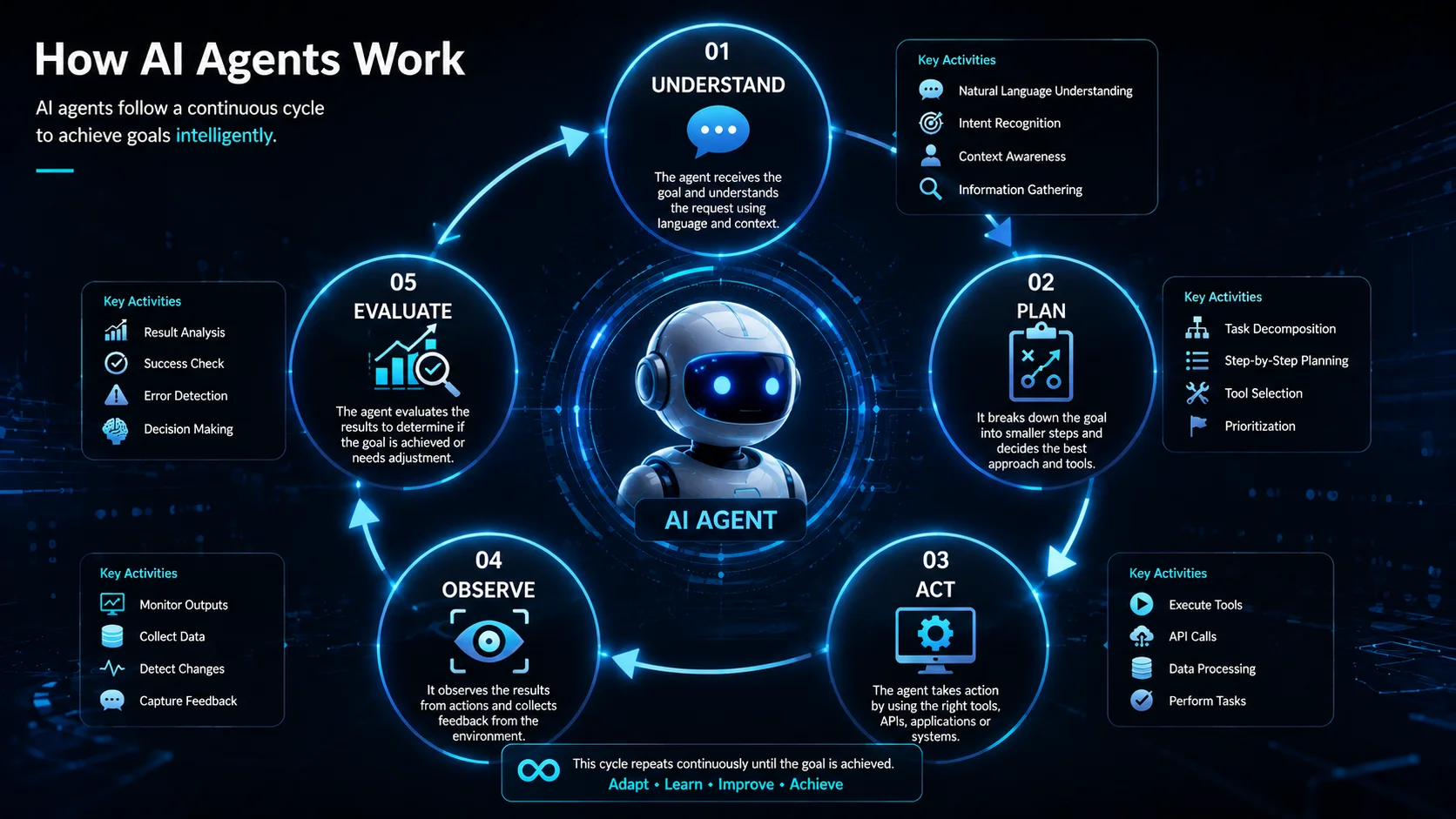
At a high level, an AI agent follows a continuous cycle:
Understand → Plan → Act → Observe → Evaluate → Repeat
The exact architecture can vary, but the basic concept remains similar.

1. Understanding the Goal
The first step is understanding what the user or system wants to accomplish.
For example:
“Prepare a weekly sales report from our latest data.”
It needs to determine what “prepare” means, what information is required, what sources should be accessed, and what the final report should contain.
2. Breaking the Task Into Steps
A complex objective can be divided into smaller tasks.
For the sales-report example, an agent might determine that it needs to:
- Access the latest sales data.
- Check whether the data is complete.
- Calculate important metrics.
- Compare current results with previous periods.
- Identify significant changes.
- Prepare a summary.
- Present the results in a readable format.
This process is often called planning.
3. Selecting the Right Tools
An important feature of AI agents is their ability to interact with external tools.
Depending on their design, agents may use:
- Search systems
- Databases
- APIs
- Spreadsheets
- Email systems
- Calendar applications
- Code execution environments
- Business software
- Document repositories
- Customer relationship management platforms
The AI model determines which tool is appropriate and provides the information required for that tool to perform its operation.
4. Taking Action
After deciding what to do, the agent performs an action.
For example, it might retrieve information from a database, search a website, calculate figures, create a document, or send information to another application.
This is one of the major differences between a simple conversational system and an agentic system.
A chatbot may say:
“You should check your sales database.”
An agent with appropriate permissions may actually connect to the database, retrieve the required information, analyze it, and prepare the requested output.
5. Observing the Result
After taking an action, the agent receives information about what happened.
For example:
- Was the database query successful?
- Did the API return the requested information?
- Was the document created correctly?
- Did the search provide enough useful information?
- Did an error occur?
The result becomes new information that the agent can use for its next decision.
6. Evaluating and Repeating
If the task is not complete, the agent can determine what should happen next.
For example, if a search does not provide enough information, the agent may modify the search strategy. If an API returns an error, it may retry or choose another available method.
This creates an iterative workflow rather than a simple input → output process.
Key Components of an AI Agent
A modern agent usually combines several technologies and capabilities.
Large Language Model
A large language model, or LLM, often serves as the reasoning and language-processing component.
It can help the agent:
- Understand natural-language instructions
- Interpret context
- Generate plans
- Select actions
- Analyze information
- Communicate results
The LLM is important, but an AI agent is more than an LLM alone.
Memory
Memory allows an agent to retain useful information across steps or, in some systems, across multiple interactions.
There are different forms of memory.
Short-term memory can contain information from the current conversation or task.
Long-term memory can store information that remains useful for future interactions, depending on the system’s design and privacy rules.
Memory can help an agent maintain context instead of treating every action as an isolated event.
Tools
Tools allow agents to interact with the outside world.
Without tools, an agent may primarily generate text. With tools, it can potentially retrieve data, perform calculations, access applications, manipulate files, and execute approved operations.
Planning
Planning enables an agent to determine the sequence of actions required to accomplish a goal.
Simple tasks may require only one or two actions, while complex workflows can involve many dependent steps.
Reasoning
Reasoning helps an agent evaluate information and determine what action makes sense next.
For example, an agent might compare multiple options and select one according to criteria provided by the user.
Feedback and Evaluation
An effective agent needs some method of determining whether its actions produced a useful result.
Evaluation can come from:
- Tool responses
- Rules
- Automated tests
- Another AI model
- Human approval
- Business logic
- Validation systems
This feedback helps the agent decide whether to continue, change direction, or finish the task.
A Simple Example of an AI Agent
Consider an AI agent designed to handle customer support.
A customer writes:
“My order has not arrived. Please check its status.”
The agent could follow this workflow:
Step 1: Understand
The agent identifies that the customer wants information about an order.
Step 2: Gather Information
It determines that an order number or customer account may be required.
Step 3: Use a Tool
The agent accesses an approved order-management system.
Step 4: Analyze the Result
The system shows that the order has been shipped but is delayed.
Step 5: Decide the Response
The agent determines what information can be safely provided to the customer.
Step 6: Respond
It explains the current delivery status and provides the available next steps.
The agent has therefore completed more than a simple question-answering task. It has interpreted a goal, accessed information, evaluated a result, and generated an appropriate response.
Types of AI Agents
There is no single universal classification for agents, but several common categories are useful for understanding them.
Reactive Agents
Reactive agents respond to current inputs without maintaining extensive historical context.
They can be useful when tasks are simple and predictable.
Goal-Based Agents
Goal-based agents are designed to achieve a particular objective.
They evaluate possible actions and select actions that move them closer to the desired result.
Planning Agents
Planning agents focus on breaking complicated objectives into a sequence of smaller tasks.
They are particularly useful for workflows involving multiple steps and dependencies.
Tool-Using Agents
Tool-using agents can interact with external systems through APIs, software applications, databases, search engines, or other connected tools.
This capability significantly expands what an agent can accomplish.
Multi-Agent Systems
A multi-agent system contains multiple specialized agents that work together.
For example, one agent might conduct research, another could analyze the findings, and another might prepare the final report.
This approach can divide complex workflows into specialized responsibilities.
AI Agents vs AI Chatbots
AI chatbots and AI agents are related, but they are not necessarily the same thing.
| Feature | AI Chatbot | AI Agent |
|---|---|---|
| Main purpose | Conversation | Task completion |
| Planning | Usually limited | Often supported |
| Tool usage | May be available | Commonly important |
| Autonomy | Usually low | Can be higher |
| Multi-step tasks | Limited | Stronger capability |
| External actions | Limited or controlled | Can perform approved actions |
| Feedback loop | Usually simple | Often iterative |
A chatbot can be considered conversational software, while an agent is generally designed around taking actions toward a goal.
However, the boundary is not always clear. Some modern AI assistants combine conversational interfaces with agent-like capabilities.
AI Agents vs Automation
AI agents should also be distinguished from traditional automation.
Traditional automation normally follows predefined instructions:

Trigger → Rule → Action
For example:
When a customer submits a form, send an acknowledgment email.
An agentic workflow can be more flexible:
Goal → Understand → Plan → Select tools → Act → Evaluate → Adjust
For example:
Review new customer inquiries, identify their intent, prioritize urgent cases, gather relevant account information, and prepare appropriate responses.
Traditional automation works extremely well when processes are predictable and structured. Agents become more useful when tasks involve unstructured information, changing conditions, judgment, or multiple possible paths.
Where Are AI Agents Used?
AI agents can be applied across many industries.
Customer Service
Agents can help answer customer questions, retrieve account information, classify requests, and assist support teams.
Software Development
Coding agents can help developers understand codebases, generate code, identify errors, write tests, and assist with debugging.
Human review remains important, particularly for production systems and security-sensitive changes.
Research
Research-oriented agents can gather information from multiple sources, organize findings, compare evidence, and prepare structured summaries.
Business Operations
Organizations can use agents to assist with reporting, document processing, workflow coordination, data analysis, and internal knowledge retrieval.
Marketing
Agents can assist with research, content planning, campaign analysis, audience segmentation, and performance reporting.
Finance
Within appropriately controlled environments, agents can assist with financial analysis, reporting, document processing, and data reconciliation.
Sensitive financial decisions should still operate under appropriate controls and human oversight.
Healthcare
AI systems can assist with administrative workflows, documentation, information retrieval, and other approved tasks. High-stakes clinical decisions require strong validation, professional oversight, privacy protection, and appropriate regulation.
Benefits of AI Agents
Greater Productivity
It can automate repetitive multi-step workflows and allow people to focus on higher-value work.
Faster Task Completion
A well-designed agent can perform several connected operations without requiring a person to manually move information between applications.
Better Workflow Integration
Because agents can work with tools and APIs, they can connect different parts of a business process.
24/7 Availability
Software-based agents can operate continuously, making them useful for services that require round-the-clock availability.
Handling Complex Workflows
Agents can potentially manage tasks that are difficult to represent using simple if-then rules.
Limitations of AI Agents
Despite their potential, AI agents are not perfect.
Incorrect Information
An agent can sometimes generate inaccurate information or make an incorrect inference.
Unreliable Tool Usage
If a tool returns incomplete, outdated, or incorrect information, the agent may make a poor decision based on that result.
Unexpected Behavior
Multi-step workflows can introduce unexpected outcomes, especially when agents have broad permissions.
Security Risks
Agents connected to external systems can create security concerns. Improper permissions, malicious instructions, compromised data, and unsafe tool access can create serious risks.
Cost
Complex agent workflows may require multiple model calls, external services, databases, and other infrastructure. This can make them more expensive than simple automation.
Human Oversight
Important decisions should not automatically be delegated to an autonomous system simply because the technology is capable of taking action.
A good implementation uses appropriate permissions, validation, monitoring, logging, and human approval where necessary.
What Is Agentic AI?
The term agentic AI generally refers to AI systems that can operate with some degree of goal-directed behavior and autonomy.
Instead of responding only to individual prompts, agentic systems can pursue objectives through multiple steps.
For example:
User goal → Planning → Tool selection → Action → Observation → Evaluation → Next action
The degree of autonomy can vary considerably.
A low-autonomy system might require human approval before every important action. A higher-autonomy system might execute several approved steps independently and request human intervention only when it encounters uncertainty or a restricted operation.
How AI Agents Use Tools
Tool use is one of the most important capabilities behind modern AI agents.
A tool can expose a specific function to the agent.
For example, an application might provide tools such as:
search_databaseget_customercalculate_totalcreate_reportsend_notification
The agent does not necessarily need to know how these functions are implemented internally. It needs to understand when a tool is appropriate and what information the tool requires.
This creates a bridge between AI reasoning and conventional software systems.
The Role of APIs in AI Agents
APIs allow software systems to communicate with one another.
It can use an API to interact with services such as:
- Databases
- Payment platforms
- Business applications
- Search services
- Communication systems
- Inventory systems
- Calendar platforms
For example, an agent could receive a customer request, use an API to retrieve account information, analyze the result, and then provide an appropriate response.
The agent therefore becomes a layer that can coordinate multiple digital services.
AI Agent Safety and Human Control
As it become more capable, safety becomes increasingly important.
A well-designed agent should operate within clearly defined boundaries.
Important controls can include:
- Permission management
- Tool restrictions
- Data access controls
- Human approval
- Activity logging
- Output validation
- Error handling
- Monitoring
- Rate limits
- Security testing
The principle is simple: an agent should have only the access and authority required to perform its job.
For high-impact operations, requiring human confirmation before an irreversible action can significantly reduce risk.
The Future of AI Agents
They are likely to become increasingly integrated into software applications and business workflows.
Instead of opening several applications and manually moving information between them, users may increasingly describe the desired outcome and allow it to coordinate the required steps.
Future systems may become better at:
- Understanding long-term objectives
- Working across multiple applications
- Handling complex workflows
- Learning from feedback
- Coordinating multiple specialized agents
- Operating under detailed permissions
- Providing clearer explanations of their actions
However, the future of agents will depend not only on model capabilities but also on security, reliability, privacy, governance, and user trust.
The most successful systems are unlikely to be those that simply maximize autonomy. Instead, they will be systems that provide the right balance between automation and human control.
Are AI Agents Fully Autonomous?
Not necessarily.
It does not automatically mean that a system can operate without human involvement.
An agent may be:
- Fully supervised
- Partially autonomous
- Human-approved
- Restricted to specific tools
- Allowed to operate independently within predefined boundaries
The level of autonomy should depend on the risk, complexity, and importance of the task.
For example, allowing it to summarize documents is relatively low risk. Allowing an agent to make an irreversible financial transaction requires much stronger controls.
How to Build a Simple AI Agent
Building an agent generally involves several stages.
Step 1: Define the Objective
Start with a clear and measurable goal.
Step 2: Choose the AI Model
Select a suitable language or reasoning model based on the task, performance requirements, cost, and security needs.
Step 3: Define Available Tools
Determine which applications, APIs, databases, or functions the agent is allowed to use.
Step 4: Create the Workflow
Design how the agent should understand the task, plan actions, use tools, evaluate results, and finish.
Step 5: Add Memory Where Needed
Provide appropriate short-term or long-term context while respecting privacy and data-retention requirements.
Step 6: Add Safety Controls
Limit permissions and define which actions require human approval.
Step 7: Test the Agent
Test normal cases, unusual inputs, failures, security scenarios, and ambiguous requests.
Step 8: Monitor Performance
Track errors, costs, response quality, tool usage, and unexpected behavior after deployment.
Common Misconceptions About AI Agents
“Every AI Agent Thinks Like a Human”
False.
Agents can perform sophisticated reasoning-like operations, but they do not necessarily possess human understanding, consciousness, or judgment.
“AI Agents Never Need Humans”
False.
Human oversight remains valuable, especially for sensitive, expensive, irreversible, or high-impact decisions.
“An AI Agent Is Just a Chatbot”
Not necessarily.
A chatbot primarily focuses on conversation, while an agent can be designed to plan and execute actions toward a goal.
“More Autonomy Is Always Better”
False.
More autonomy can increase both productivity and risk. The appropriate level depends on the task.
Frequently Asked Questions About AI Agents
1. What is an AI agent in simple words?
An AI agent is a software system that can understand a goal, decide what actions are needed, use available tools, and work toward completing the task.
2. What is the difference between an AI agent and a chatbot?
A chatbot primarily communicates with users. An AI agent can go beyond conversation by planning tasks, using tools, and taking approved actions.
3. Do AI agents use ChatGPT?
Some AI agents can use large language models such as GPT-based models as part of their architecture. However, an AI agent is a broader system that can include models, tools, memory, APIs, databases, and control mechanisms.
4. Can AI agents work without humans?
Some can operate with a high degree of autonomy, but complete independence is not always desirable. Human supervision is particularly important for high-risk tasks.
5. Can an AI agent access my computer?
Only if it has been given appropriate access through the software environment in which it operates. Permissions and security controls determine what an agent can access or change.
6. Are AI agents expensive?
Costs vary depending on the model, number of tasks, tool usage, infrastructure, and complexity of the workflow.
7. Can AI agents make mistakes?
Yes. Agents can misunderstand instructions, use incorrect information, make poor decisions, or encounter tool failures. Testing and monitoring are therefore essential.
8. Are AI agents useful for businesses?
Yes. They can assist with customer support, research, reporting, document processing, software development, data analysis, and many other workflows.
9. Can multiple AI agents work together?
Yes. A multi-agent architecture can assign different responsibilities to specialized agents and coordinate their outputs.
10. Will AI agents replace human workers?
The impact will vary by industry and occupation. Agents are more likely to automate specific tasks and change workflows than simply eliminate every role. Human judgment, creativity, accountability, communication, and domain expertise will remain important.
Conclusion
AI agents represent an important shift in the development of artificial intelligence. Instead of simply responding to prompts, they can be designed to understand objectives, plan multi-step workflows, use tools, evaluate results, and take approved actions.
Their real value comes from combining AI models with software tools, memory, APIs, planning systems, and safety controls. This allows them to participate in practical workflows rather than remaining limited to conversation.
At the same time, greater capability brings greater responsibility. Security, privacy, reliability, permissions, monitoring, and human oversight are essential when deploying agents in real-world environments.
The future of AI will not be defined only by how intelligent models become. It will also depend on how effectively those models can be turned into reliable, useful, and controllable agents that help people accomplish meaningful goals.
Computer Engineering terminologies Part 1
Check out www.globaledutechpro.com for Educational posts